

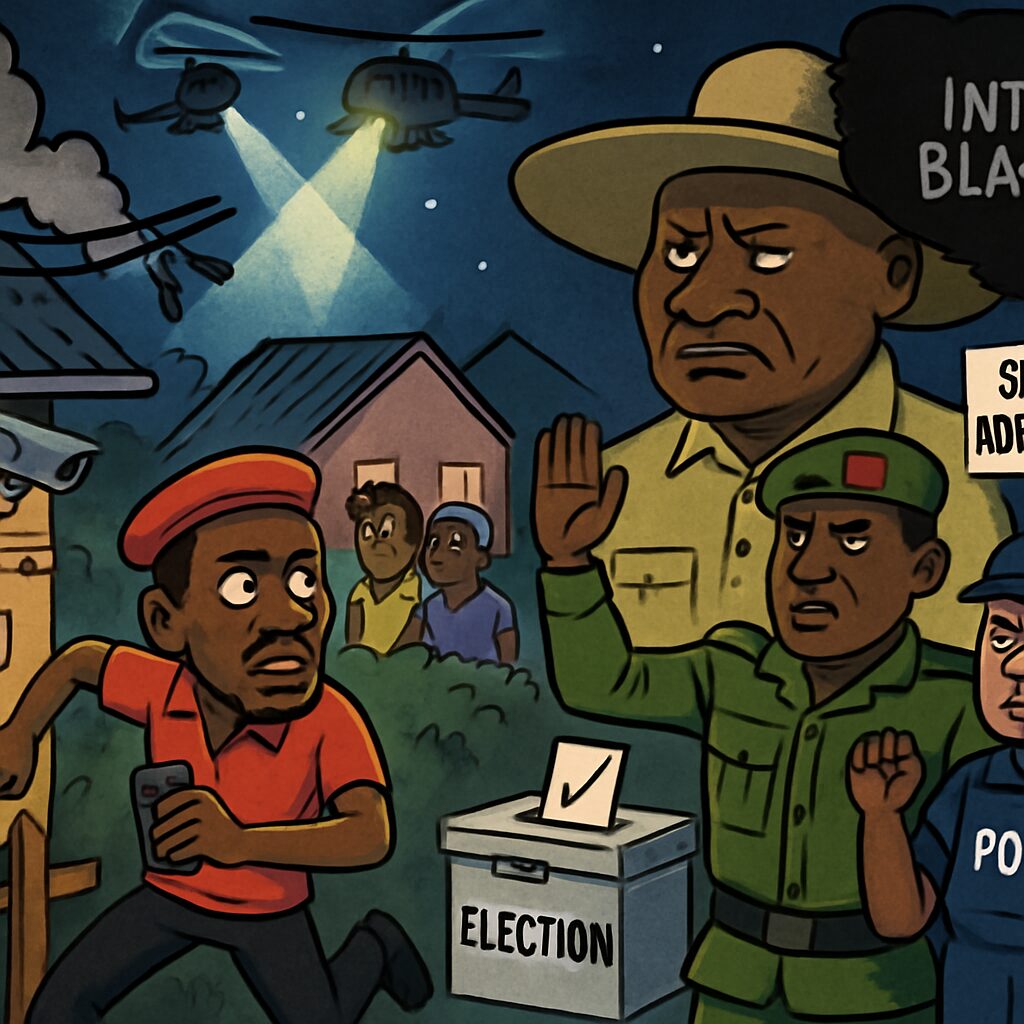
Ugandan opposition leader Bobi Wine claims to have escaped a police and army raid on his home, while authorities deny abducting him by helicopter, as incumbent President Yoweri Museveni secures a disputed electoral victory. This incident highlights the tense political climate in Uganda, where Museveni is set to extend his 40-year rule amid allegations of fraud and repression.
Bobi Wine, a pop star-turned-politician, stated in a social media post that he managed to flee during an overnight raid by security forces on his house in Kampala. He described how military and police personnel switched off power and cut CCTV cameras, with helicopters hovering overhead, leading to confusion among neighbors who spread abduction claims. Wine emphasized that his wife and other family members remain under house arrest, unable to leave the premises.
Ugandan police swiftly denied the allegations, with spokesman Kituuma Rusoke asserting that Wine was still at home and accusing his family of spreading unfounded claims. Rusoke explained that access to Wine’s residence was restricted due to security concerns, aimed at preventing gatherings that could cause chaos. The military also rejected the abduction story, labeling it as false and part of a broader narrative of misinformation.
The raid occurred against the backdrop of a presidential election where Museveni, 81, was declared the winner with approximately 72% of the vote, based on returns from most polling stations. Wine, who garnered about 24%, has condemned the results as fake, alleging ballot stuffing and other irregularities without providing concrete evidence. The election commission has stood by the tally, scheduling the final announcement amidst growing skepticism.
Violence marred the election period, with reports of at least seven opposition supporters killed overnight in Butambala and additional fatalities in other regions. Wine claimed that a total of 11 people lost their lives due to security force actions, though authorities have not confirmed these numbers. The US embassy issued alerts warning citizens of potential unrest, citing incidents of tear gas and live fire to disperse crowds.
A nationwide internet blackout, imposed since Tuesday, has complicated information verification and fueled speculation. Uganda’s communications regulator cited the need to prevent misinformation and violence, but the move has been criticized by human rights organizations as suppressing free speech. Wine appealed for the restoration of internet access to allow genuine results to be uploaded and shared publicly.
The campaign was characterized by widespread repression, according to UN assessments, with opposition activities disrupted and supporters detained. Museveni, in power since 1986, portrays himself as a stabilizer in a historically conflict-prone country, while Wine represents a youthful population seeking change and anti-corruption reforms. The election’s credibility is under scrutiny, with international observers raising concerns over fairness.
Looking ahead, the political standoff threatens to escalate, with Wine calling for non-violent protests and rejecting Museveni’s legitimacy. The prolonged rule of Museveni, now extending into a seventh term, raises questions about Uganda’s democratic trajectory and stability in the region. As tensions simmer, the focus shifts to how both domestic and international actors will respond to the deepening crisis.

