

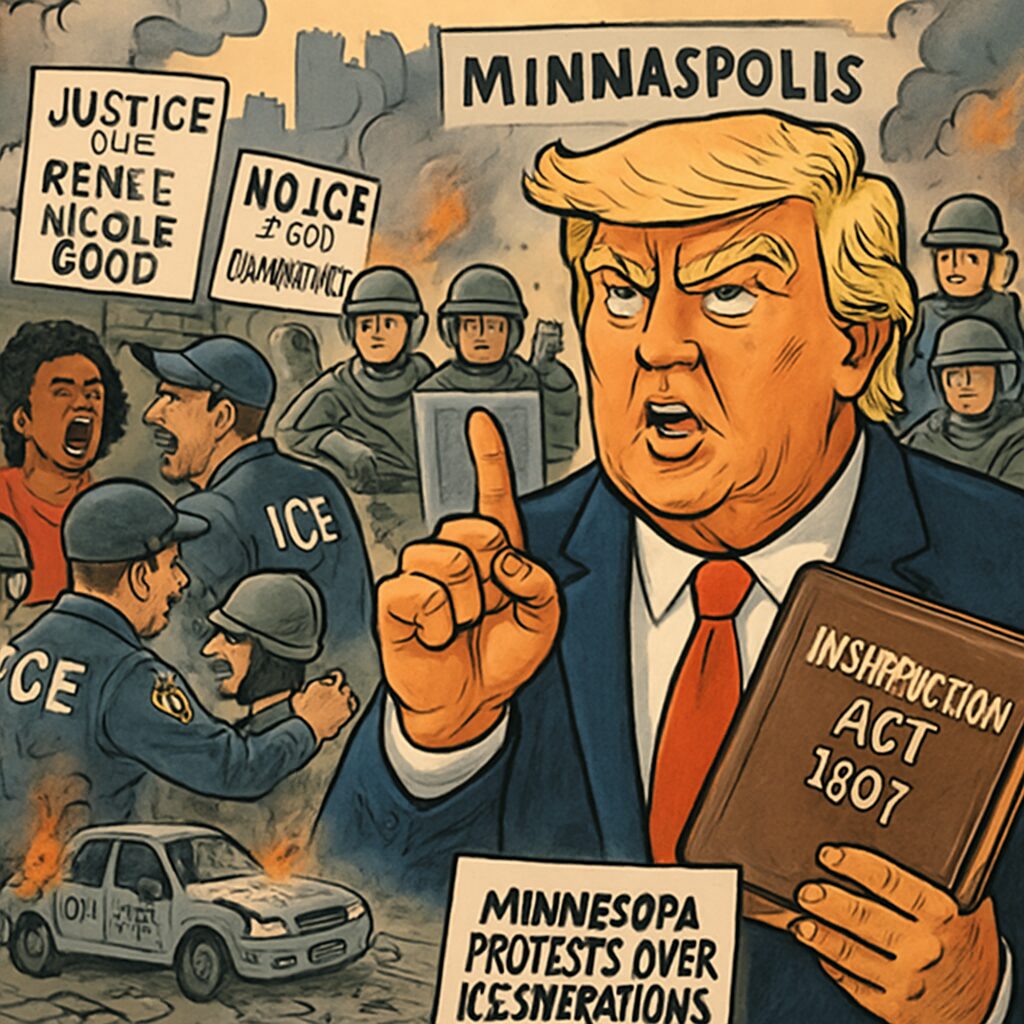
President Donald Trump has threatened to invoke the Insurrection Act to deploy military forces in Minneapolis, Minnesota, in response to ongoing protests against federal immigration enforcement operations. The threat follows a night of violent clashes and a shooting incident involving ICE agents.
The protests erupted after an ICE agent shot a man in the leg during a confrontation in north Minneapolis on Wednesday night. According to the Department of Homeland Security, the officer was attacked by three Venezuelan nationals with a shovel and broom handle after a car chase, leading to the defensive shooting that injured one assailant non-fatally. This incident sparked immediate unrest in the Hawthorne area, where protesters clashed with law enforcement, resulting in damaged government vehicles and minor injuries.
This violence is part of a broader wave of demonstrations triggered by the fatal shooting of 37-year-old Renee Nicole Good by an ICE agent on January 7. Local officials argue that Good posed no threat, while federal authorities claim the agent acted in self-defense. The ongoing ICE operations, known as Operation Metro Surge, have intensified tensions, with Minneapolis Mayor Jacob Frey demanding that ICE leave the city and Governor Tim Walz calling for de-escalation.
In response to the protests, Trump posted on Truth Social, threatening to use the Insurrection Act if state officials failed to stop what he called “professional agitators and insurrectionists.” DHS Secretary Kristi Noem defended the federal agents, stating that the officer was “ambushed and attacked” and emphasizing the need to protect law enforcement. Meanwhile, Governor Walz, a Democrat, directly appealed to Trump to “turn the temperature down,” highlighting the political divide over the handling of the crisis.
The Insurrection Act, enacted in 1807, allows the president to deploy active-duty military personnel for domestic law enforcement under certain conditions. Trump has previously threatened to invoke this rarely used law but has not done so. Legal proceedings are ongoing, with a federal judge recently denying a temporary restraining order sought by Minnesota prosecutors to block ICE deployments, thus allowing the operations to continue.
Currently, approximately 3,000 federal officers are deployed in Minnesota, and the FBI has offered a reward of up to $100,000 for information leading to the recovery of stolen government property or arrests related to the protests. The situation remains volatile, with nightly protests and heightened security measures. Public sentiment is polarized, as seen in online fundraisers that have raised over $1.4 million for Good’s family and $740,000 for the ICE agent involved.
This escalation underscores deep-seated conflicts over immigration policy and the role of federal enforcement in local communities. As tensions persist, the possibility of military intervention adds a new layer of complexity, with potential implications for civil liberties and federal-state relations. The coming days will be critical in determining whether diplomatic efforts or further force will shape the resolution of this crisis.

