

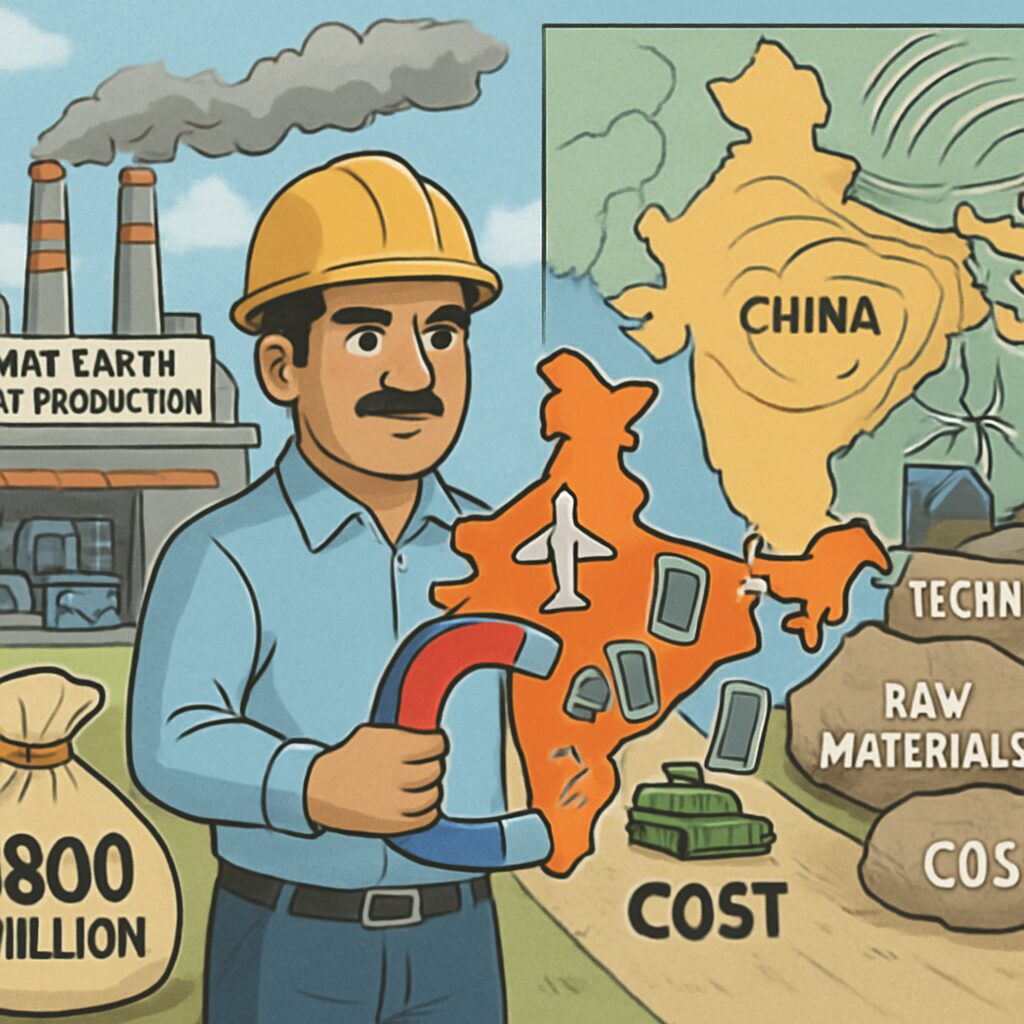
India has launched an ambitious $800 million plan to manufacture rare earth magnets domestically, aiming to cut its heavy reliance on Chinese imports. However, experts caution that achieving self-reliance will require overcoming significant technological and logistical hurdles.
In November 2025, India approved a 73-billion-rupee (approximately $800 million) scheme to incentivize selected manufacturers to produce 6,000 tonnes of permanent magnets annually within seven years. This initiative is designed to meet rapidly growing domestic demand, which officials expect to double over the next five years, driven by sectors such as electric vehicles, wind turbines, smartphones, and defense equipment.
Rare earth magnets are critical components in modern technology, and China currently dominates the global supply chain, controlling over 90% of processing. India imports 80-90% of its magnets and related materials from China, a dependency that was starkly exposed during recent trade disputes when China tightened exports, disrupting Indian industries. This vulnerability has spurred India and other nations like the EU and Australia to seek alternatives and reduce geopolitical risks.
Despite substantial financial backing, India faces a steep learning curve in magnet production. Countries such as Japan, South Korea, and Germany have decades of industrial expertise, whereas India has virtually no commercial-scale experience. Experts like Neha Mukherjee of Benchmark Mineral Intelligence stress that strategic partnerships to import technology and skill up the workforce are essential for building indigenous capabilities.
Raw material availability presents another major hurdle. India holds the world’s third-largest rare earth reserves, about 8% of the global total, primarily in coastal sands. However, it accounts for less than 1% of global mining, with only one operational mine in Andhra Pradesh. Moreover, India has surpluses of lighter rare earths like neodymium but lacks extractable quantities of heavier elements such as dysprosium and terbium, which are crucial for high-performance magnets.
Even if production scales up, meeting demand remains a concern. Current annual consumption is estimated at 7,000 tonnes, and the target of 6,000 tonnes by the early 2030s may fall short as demand accelerates. Without rapid capacity expansion, India could remain dependent on China, which continues to scale its own production.
Competitive pricing is also a challenge, as Chinese magnets are cheap and imports could still dominate unless Indian-made alternatives are cost-effective. Some analysts suggest that incentives should extend to buyers to encourage adoption of domestic products.
Despite these obstacles, the scheme marks a recognition of India’s ambition to bolster its rare earth ecosystem. Rajnish Gupta of EY India notes that while the path is complex, taking this step is better than inaction, highlighting a commitment to long-term strategic autonomy in a critical industry.

