

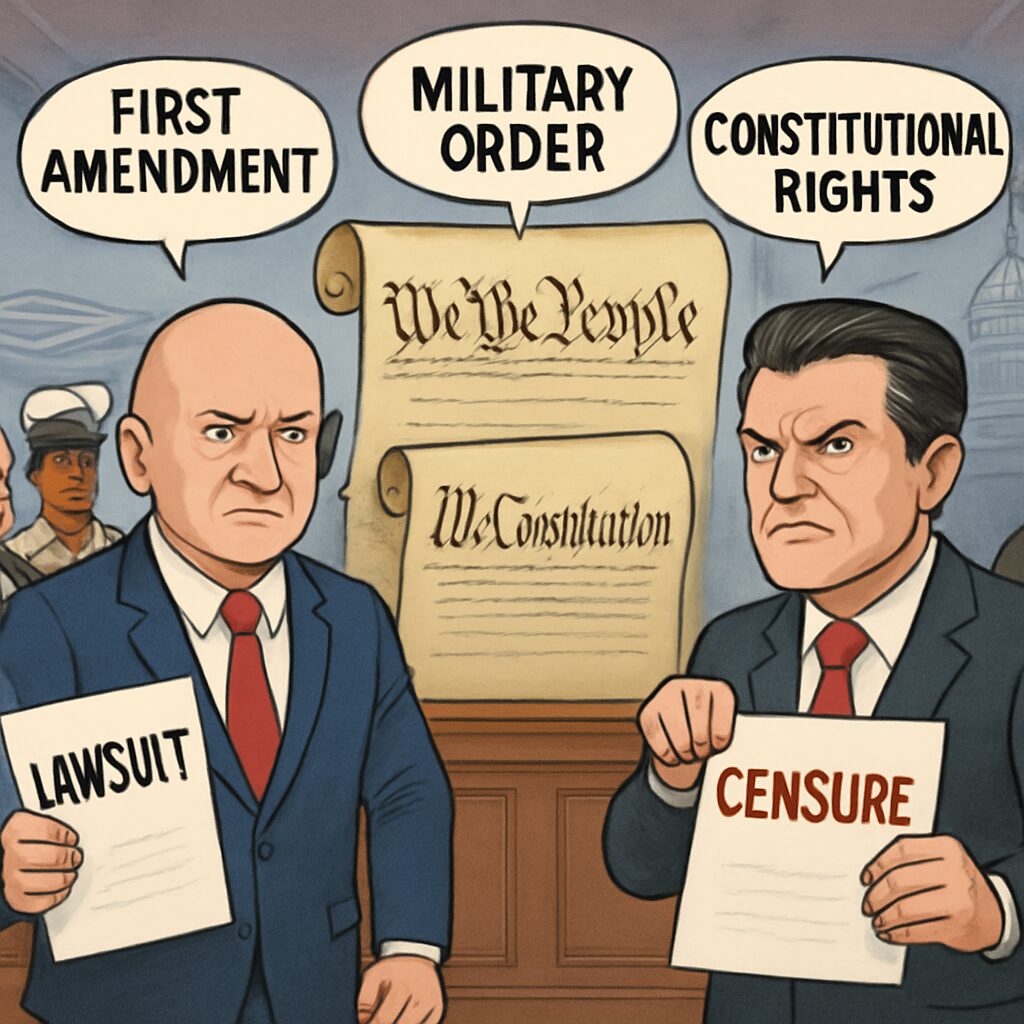
In a bold legal move, Democratic Senator Mark Kelly has filed a lawsuit against Defense Secretary Pete Hegseth, accusing him of violating Kelly’s constitutional rights by censuring him and seeking to reduce his military rank and retirement pay. This action stems from Kelly’s participation in a video that encouraged U.S. service members to refuse unlawful orders, a move that has sparked a high-stakes confrontation between legislative oversight and executive authority.
The lawsuit, filed on Monday, January 12, 2026, names Hegseth, the Department of Defense, the Navy, and Navy Secretary John Phelan as defendants. Kelly alleges that Hegseth’s censure, issued on January 5, 2026, for what he described as “seditious” conduct, is a retaliatory measure aimed at punishing protected speech. The censure letter, obtained by CNN, claims that Kelly’s video specifically counseled service members to refuse particular operations deemed illegal, rather than providing abstract legal education.
Kelly’s legal team argues that the punishment violates the First Amendment, the speech and debate clause protecting lawmakers, and his right to due process. In a statement, Kelly emphasized, “Pete Hegseth is coming after what I earned through my twenty-five years of military service,” and warned that such actions send a chilling message to retired veterans who speak out. The lawsuit seeks to block the Pentagon’s efforts to downgrade Kelly’s rank and cut his pay, asserting that this would inflict immediate and irreparable harm.
The controversy centers on a video posted in November 2025, in which Kelly and five other Democratic lawmakers with military backgrounds urged troops to reject illegal orders that could be issued by the Trump administration. Hegseth and former President Donald Trump have publicly condemned the video, with Trump calling it “sedition” and suggesting the lawmakers should be jailed. Hegseth has defended his censure as necessary to maintain unit cohesion and the chain of command.
Legal experts, however, have questioned the basis for reducing a retired officer’s rank. Rachel VanLandingham, a former Air Force judge advocate, stated that there is “no legal basis” for such actions post-retirement, unless the officer is convicted in a court-martial or for espionage. She characterized Hegseth’s efforts as an “abuse of power,” noting that the video’s content aligns with standard military legal advice provided to service members.
The tension between Kelly and Hegseth has escalated beyond legal filings, including a heated exchange during a classified Senate briefing where Hegseth accused Kelly of undermining military discipline. This personal clash underscores the broader political divide, with Kelly positioning himself as a defender of legislative independence against executive overreach.
If Hegseth’s actions proceed, they could set a precedent for punishing retired military personnel for political speech, potentially stifling criticism from veterans. The lawsuit highlights concerns about the separation of powers, as it involves a sitting senator being targeted through military channels for his oversight activities.
As the legal battle unfolds, the outcome may have significant implications for the rights of retired service members and the limits of executive authority. The Pentagon has declined to comment on the litigation, citing policy, while Kelly remains defiant, vowing not to back down in what he sees as a fight for constitutional principles. This summary is based on reports from CNN and ABC News, synthesizing key details into a unified narrative.

