

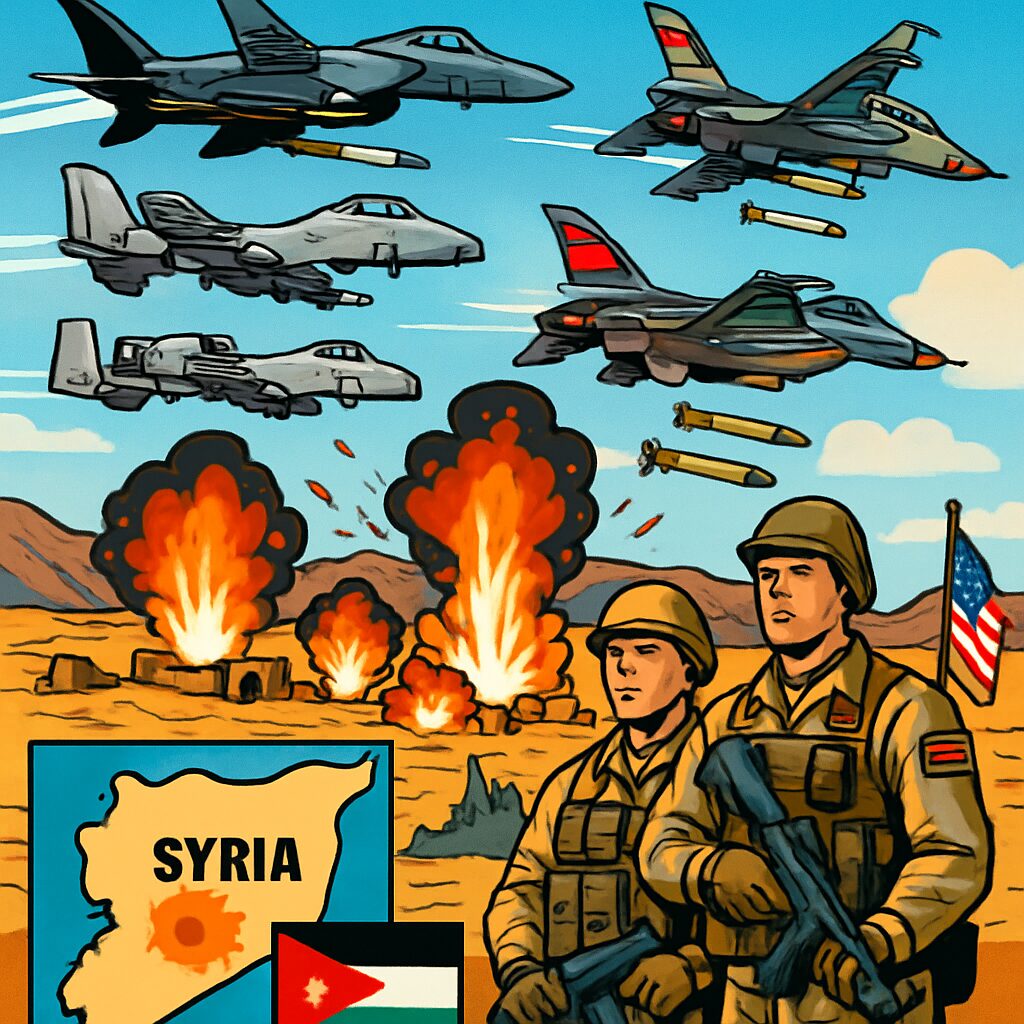
The U.S. military, alongside partner forces including Jordan, has conducted large-scale retaliatory strikes against Islamic State group targets in central Syria, responding to a deadly attack on American personnel earlier this month. This operation, part of the ongoing Operation Hawkeye Strike, involved over 90 precision munitions targeting more than 35 locations, with aircraft such as F-15Es, A-10s, and Jordanian F-16s participating in the coordinated effort.
The strikes were triggered by an ambush on December 13, where an Islamic State gunman killed two U.S. soldiers and an American civilian interpreter during a meeting with Syrian security forces near Palmyra. This attack, which also wounded several others, prompted U.S. President Donald Trump to pledge retaliation, leading to the formulation of Operation Hawkeye Strike aimed at eliminating IS fighters and infrastructure in the region.
According to U.S. Central Command, the recent strikes employed more than 20 aircraft and targeted known IS weapons sites and operational hubs across central Syria. Jordan confirmed its air force’s involvement, stating that the precise airstrikes aimed to prevent extremist groups from using southern Syria as a launchpad for attacks, highlighting the international coalition’s efforts to degrade IS capabilities.
The Syrian Observatory for Human Rights reported at least five casualties from the strikes, including members of an IS cell, though the U.S. military has not released official figures on fatalities. Prior to this operation, U.S. and partner forces had conducted several missions in December, resulting in the death or detention of nearly 25 IS operatives, as part of a broader counterterrorism strategy in the area.
Defense Secretary Pete Hegseth emphasized the U.S. commitment to avenging attacks on its personnel, stating, “Our message remains strong: if you harm our warfighters, we will find you and kill you anywhere in the world.” The strikes underscore a continued military presence in Syria, where hundreds of U.S. troops are deployed to support local forces and maintain pressure on militant groups.
The operation occurs amid a fragile political landscape in Syria, following the ouster of President Bashar al-Assad in late 2024 and the rise of interim President Ahmad al-Sharaa, who has expressed support for the U.S. actions. IS, though weakened, remains active in the region, carrying out sporadic attacks against Kurdish-led forces and posing a persistent threat to stability.
Looking ahead, U.S. officials indicate that similar strikes may continue as part of Operation Hawkeye Strike, with a focus on dismantling IS networks and preventing future attacks. The collaboration with Jordan and other coalition members reflects an ongoing international effort to combat terrorism in the Middle East, even as the region grapples with complex security challenges.
In summary, the retaliatory strikes represent a significant escalation in U.S. military engagement in Syria, driven by a direct threat to American lives and a broader strategy to neutralize Islamic State influence. As operations persist, the impact on regional dynamics and counterterrorism efforts will be closely monitored by global observers.

