

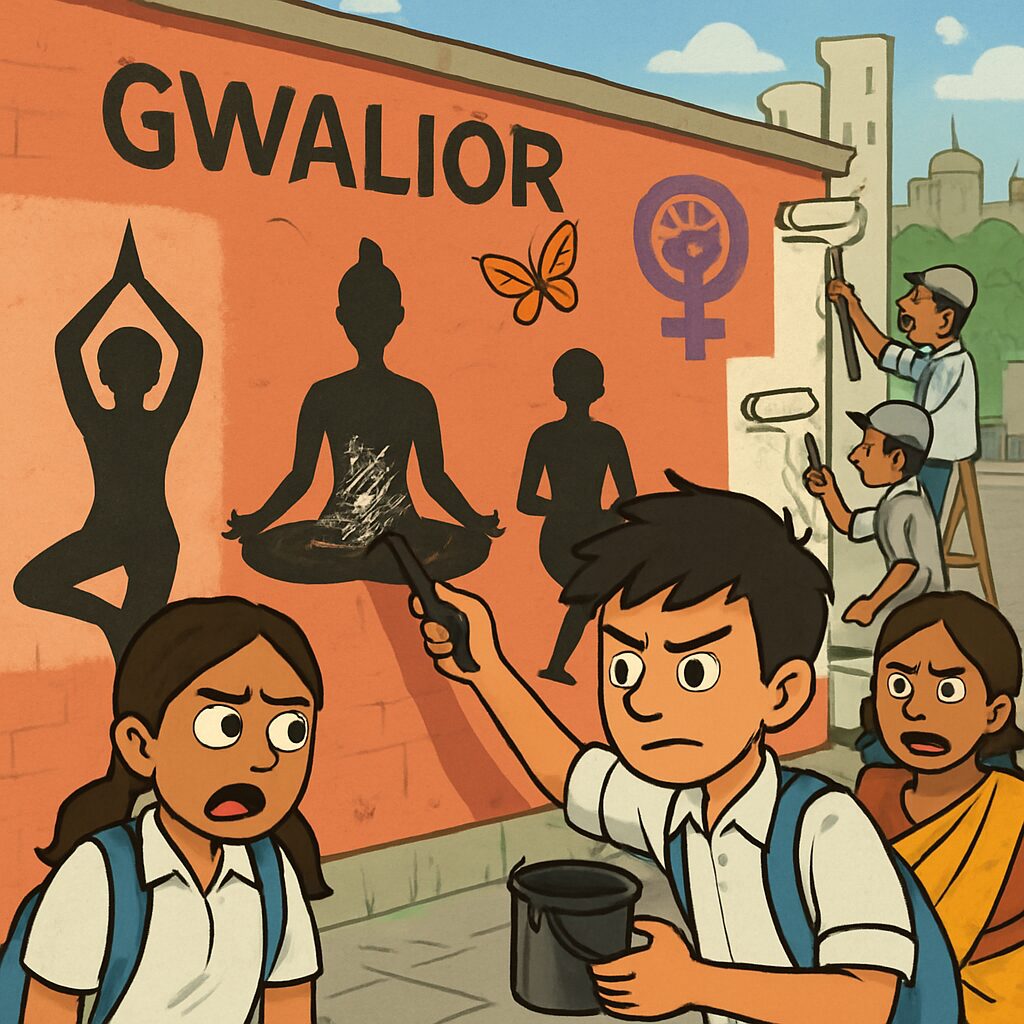
In the Indian city of Gwalior, female yoga murals were defaced with obscene markings, sparking widespread outrage and leading city authorities to whitewash the walls. This incident has highlighted broader issues of women’s safety and the sexualization of public art.
A recent viral video revealed defaced artwork on a public wall in Gwalior, where black silhouettes of women practicing yoga had white scratches around their genital areas. The video was posted by a school student on Instagram, who described feeling “anger and disgust” upon seeing the vandalism daily. She condemned the act as “cheap thinking, dirty mentality, and deep disrespect,” emphasizing that even artistic depictions of women are not safe from such mindsets.
The video rapidly circulated on social media, eliciting strong reactions from users who labeled it an attack on women’s dignity. Many expressed that the sight made them “uneasy” and highlighted the pervasive nature of threats to women’s safety, even in graffiti. Media coverage described the vandalism as “shameful” and “embarrassing,” amplifying public condemnation.
In response to the outcry, Lokendra Singh, a local college student and social media influencer, took matters into his own hands by painting over the offensive marks with black paint. Singh stated that “it requires a lot of courage to make something right, especially in a public space,” and his actions were met with online support. His video also went viral, drawing further attention to the issue.
Subsequently, the Gwalior Municipal Corporation intervened, with workers whitewashing the defaced walls. Corporation spokesman Umesh Gupta blamed “some miscreants” for the vandalism and noted the lack of CCTV cameras hindering identification. Gupta announced that after whitewashing, new paintings would be commissioned, though it remains unclear if the original yoga-themed artwork will be restored.
However, activists argue that whitewashing is a superficial fix that overlooks the root cause: a mindset that sexualizes female representations. Kalpana Viswanath, co-founder of Safetipin, an organization focused on women’s safety in public spaces, explained that such vandalism constitutes sexual harassment, whether directed at women or art. She stressed that addressing this requires engaging young men to understand the harm in their actions.
The murals were part of a city beautification initiative in Madhya Pradesh state, reflecting India’s broader efforts to promote yoga through public art. Yet, this incident exposes the fragility of women’s access to public domains in a society where men dominate. Viswanath pointed out that events like this “add to the list of things that further restrict our access,” as families often urge women to retreat after such occurrences.
Globally, similar patterns exist, such as bronze statues with discolored breasts from inappropriate touching, indicating a cross-cultural issue. Despite the challenges, Viswanath finds hope in the resilience of young women from smaller cities who are vocal against patriarchy. Their courage in speaking out, as seen in this case, represents an active voice for change, pushing for deeper societal shifts beyond temporary repairs.

