

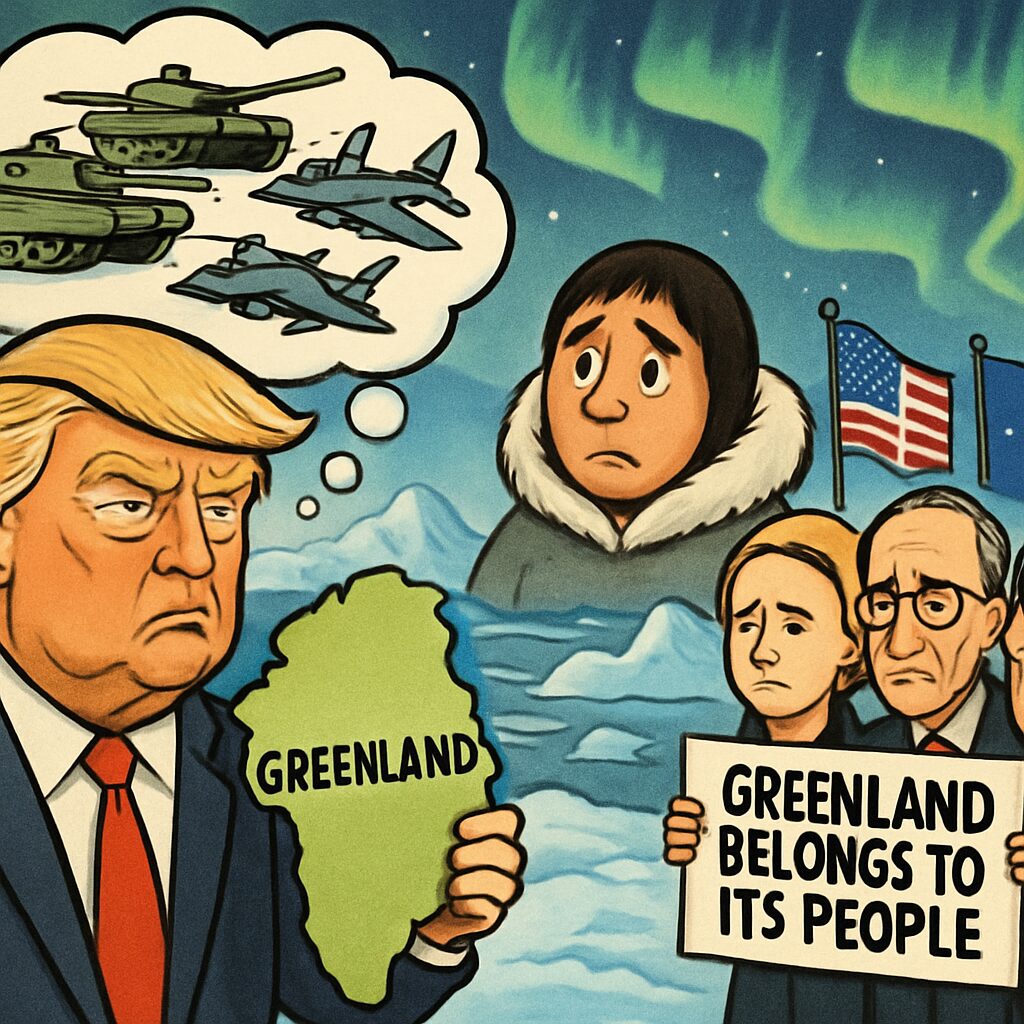
The White House has confirmed that President Donald Trump is actively considering a range of options to acquire Greenland, with the use of military force not ruled out, raising alarms among European allies and intensifying geopolitical tensions. This development follows Trump’s repeated assertions that controlling the Arctic island is a national security priority for the United States.
On Tuesday, White House press secretary Karoline Leavitt stated that Trump and his advisers are “discussing a range of options” to pursue this goal, explicitly mentioning that “utilizing the U.S. Military is always an option at the Commander in Chief’s disposal.” This statement was echoed in communications to media outlets, including the BBC and CNN, underscoring the administration’s firm stance. The push comes amid growing U.S. concerns over Russian and Chinese activities in the Arctic, where Greenland’s strategic location and untapped resources, such as rare earth minerals, are seen as critical.
The announcement prompted swift backlash from Denmark, which governs Greenland as a semi-autonomous territory. Danish Prime Minister Mette Frederiksen warned that any U.S. military action against Greenland could spell the end of NATO, highlighting the severe implications for trans-Atlantic security. Greenland’s Prime Minister Jens-Frederik Nielsen called for “respectful dialogue,” emphasizing that the island’s status is rooted in international law and territorial integrity. Many Greenlanders, who overwhelmingly oppose becoming part of the U.S., expressed fear and frustration, with one resident describing Trump’s rhetoric as “terrifying.”
In response, European leaders issued a joint statement on Tuesday expressing solidarity with Denmark. The heads of state from the UK, France, Germany, Italy, Poland, Spain, and Denmark affirmed that “Greenland belongs to its people” and that security in the Arctic must be achieved collectively through NATO allies. They stressed the importance of upholding UN Charter principles, including sovereignty and territorial integrity, signaling a unified front against unilateral U.S. actions.
Trump’s interest in Greenland is not new; he first floated the idea of purchasing the territory during his initial term, calling it “a large real estate deal.” Since his re-election, the administration has revived this ambition, with senior aide Stephen Miller asserting that it is “the formal position of the U.S. government that Greenland should be part of the U.S.” The recent focus has been fueled by Trump’s expansionist foreign policy, including the recent capture of Venezuelan leader Nicolás Maduro, which has raised concerns about similar tactics being applied elsewhere.
Domestically, the administration’s stance has drawn criticism from both Democrats and Republicans. Senator Ruben Gallego, a Democrat, announced plans to introduce a resolution to prevent a U.S. invasion of Greenland, while Republican Representative Don Bacon condemned the rhetoric as “appalling” and urged an end to what he called “stupid BS.” Bipartisan senators reaffirmed the U.S. partnership with Denmark, warning that coercion undermines NATO principles.
The situation poses significant risks to NATO cohesion, as Denmark is a longstanding member of the alliance. Secretary of State Marco Rubio has attempted to downplay military concerns, telling lawmakers that the administration is considering options like purchasing Greenland or forming a Compact of Free Association. However, the explicit mention of military force has strained diplomatic relations and could weaken trust among allies.
Looking ahead, the U.S. and Denmark are expected to engage in further discussions, with Greenland requesting a meeting with Rubio to address the claims. The outcome will likely hinge on whether the Trump administration pursues diplomatic avenues or escalates tensions, with potential consequences for Arctic security and international norms. As tensions simmer, the world watches closely to see if this geopolitical standoff will lead to conflict or compromise.

