

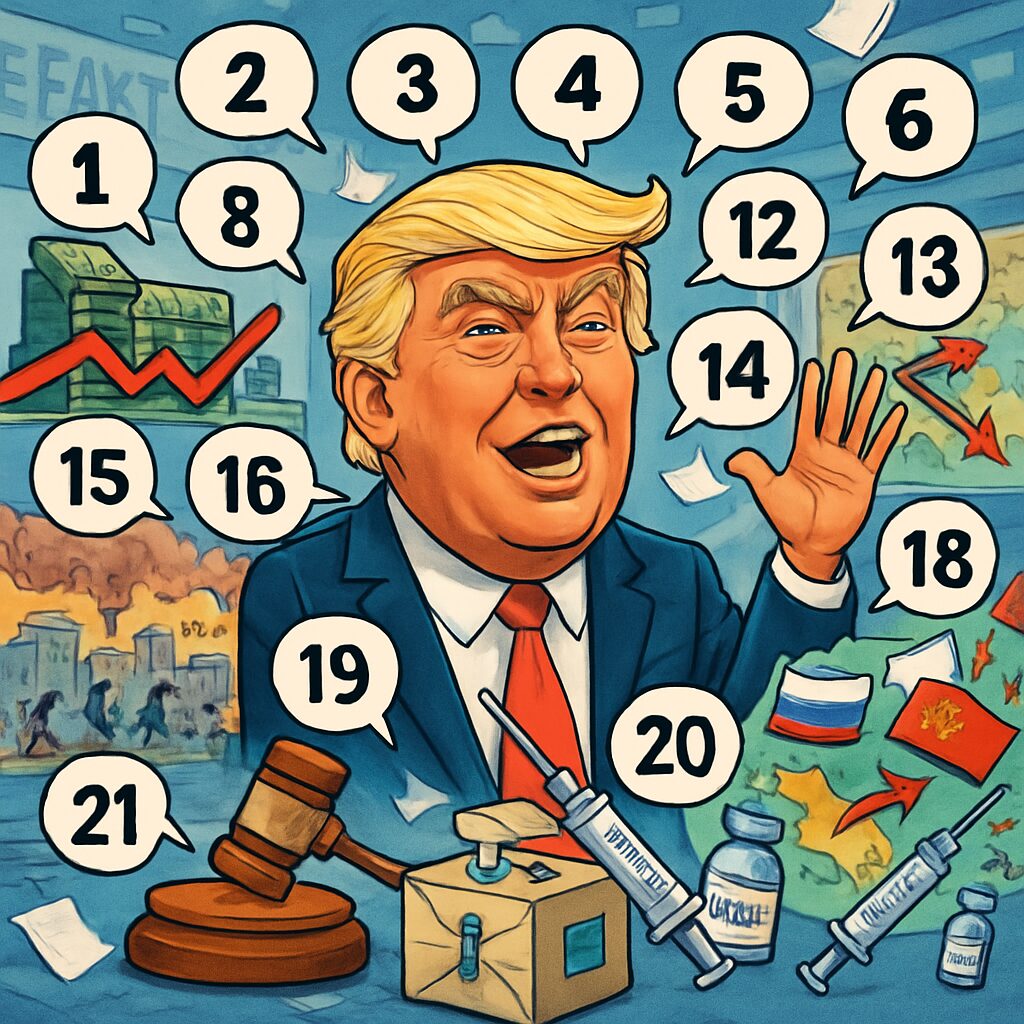
In a comprehensive analysis published on December 27, 2025, CNN fact-checker Daniel Dale detailed President Donald Trump’s top 25 false claims from his first year back in the White House, underscoring a pattern of repetitive and often brazen lies that spanned critical issues from the economy to foreign policy. The report, also featured on Yahoo News, highlights how Trump’s dishonesty became a defining feature of his presidency, with false assertions repeated despite consistent debunking.
Dale noted that while Trump has always been prone to falsehoods, 2025 saw his lying become especially repetitive, with a core set of go-to fabrications deployed regardless of setting or prior debunking. This consistency made compiling the list both challenging and indicative of the president’s disregard for factual accuracy, as he often chose dramatic untruths over verifiable facts that could have served his narrative if stated correctly.
On economic matters, Trump repeatedly made implausible claims, such as securing $17 to $18 trillion in investment—a figure contradicted by his own administration’s data, which showed less than $10 trillion—and asserting that ‘every price is down’ despite widespread inflation affecting thousands of products. He also falsely stated that foreign countries pay U.S. tariffs, when in reality, U.S. importers bear the cost, and claimed he was reducing prescription drug prices by ‘2,000% to 3,000%,’ numbers that are mathematically impossible and ignore real, though smaller, price reductions.
In the realm of public safety, Trump falsely claimed that Portland was ‘burning down’ due to sporadic protests, ignoring that the city was largely calm, and that Washington, D.C., had no murders for six months after his federal takeover, despite over 50 homicides in that period. He even fabricated a heroic tale about ‘invading Los Angeles’ to open water flow, a stunt unrelated to the city’s issues, and made up praise from Maryland Governor Wes Moore, claiming the Democrat called him ‘the greatest president of my lifetime,’ a statement debunked by video evidence from their meeting.
Foreign affairs were another hotspot for misinformation. Trump reversed history by blaming Ukraine for starting the war with Russia, claimed he was ‘in jest’ when promising to end the conflict quickly—a pledge he made seriously during his campaign—and invented stories about $50 million for ‘condoms for Hamas’ to justify aid cuts. He also asserted that every drug boat in the Caribbean kills 25,000 Americans, a figure that contradicts overdose death statistics, and that numerous foreign leaders empty prisons to send migrants to the U.S., a claim unsupported by any evidence from his administration.
Regarding justice and elections, Trump continued to deny the violence of the January 6 insurrection, falsely stating that rioters ‘didn’t assault’ anyone and that media criticism is ‘illegal.’ He also pressured the Justice Department to target political opponents like James Comey and Letitia James while publicly denying it, and persisted in lying about the 2020 election being ‘rigged and stolen,’ despite numerous audits and court rulings confirming its integrity. Additionally, he made false claims about mail-in voting and birthright citizenship, incorrectly stating the U.S. is the only country with such policies.
On health care and legislation, Trump spread dangerous vaccine misinformation, claiming babies receive ’80-plus vaccines at once,’ which is factually incorrect, and made false statements about various policies to support his agendas. These lies not only mislead the public but also pose risks to public health and democratic processes.
Overall, Dale’s analysis reveals how Trump’s lies in 2025 not only misled the public but also undermined trust in institutions and fact-based discourse. The repetitive nature of these falsehoods suggests a strategic effort to shape narratives, posing ongoing challenges for journalists and citizens in discerning truth in the political arena. As fact-checkers continue to document these inaccuracies, the impact on public perception and policy debates remains a critical concern for the nation.

