

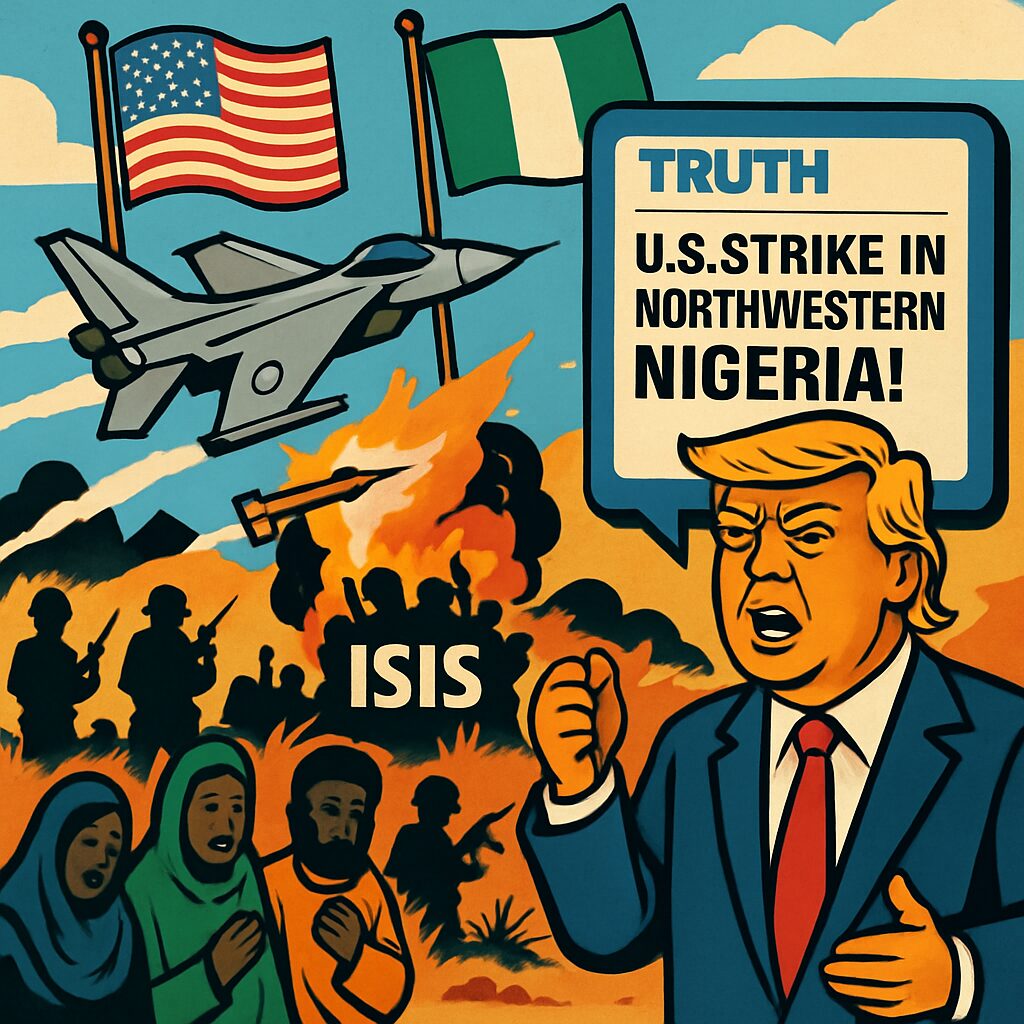
On December 25, 2025, President Donald Trump announced that the United States had launched deadly military strikes against Islamic State militants in northwestern Nigeria, escalating U.S. involvement in a region plagued by long-standing insurgencies. The operation, described as a ‘powerful and deadly strike,’ targeted ISIS forces in Sokoto state and was conducted in coordination with Nigerian authorities.
President Trump made the announcement via a post on his social media platform, Truth Social, late on Christmas Day. He stated that the strike was directed against ‘ISIS Terrorist Scum’ who have been ‘targeting and viciously killing, primarily, innocent Christians.’ The U.S. Africa Command confirmed the operation, noting it was carried out at the request of the Nigerian government and resulted in the deaths of multiple ISIS terrorists. Defense Secretary Pete Hegseth expressed gratitude for Nigerian cooperation and hinted at potential future actions.
This military action follows weeks of escalating rhetoric from Trump, who in November ordered the Pentagon to prepare for potential intervention in Nigeria. He has repeatedly accused the Nigerian government of failing to protect Christians from persecution by Islamist militant groups. In response, the U.S. State Department designated Nigeria a ‘country of particular concern’ under religious freedom laws and imposed visa restrictions on individuals involved in violence against Christians.
Nigerian officials have emphasized that the strike was a joint operation planned with U.S. forces and based on shared intelligence. Foreign Minister Yusuf Maitama Tuggar told the BBC that the operation targeted ‘terrorists’ and was not motivated by religion. He acknowledged that further strikes could occur depending on decisions by both countries’ leaderships. Nigeria’s government has consistently stated that extremist violence affects people of all faiths, not just Christians.
The security situation in Nigeria is complex, with multiple militant groups operating across the country. In the northeast, Boko Haram and Islamic State West Africa Province have waged a brutal insurgency for over a decade, resulting in thousands of deaths, predominantly among Muslims. In central regions, frequent clashes between Muslim herders and Christian farmers over resources have led to cycles of violence, with atrocities committed on both sides. Human rights groups note no evidence of Christians being disproportionately targeted.
Trump’s focus on Christian persecution has sparked debate among experts and residents, who argue that the reality is more nuanced. While some attacks on churches and schools have occurred, militants often target both religious communities. The Nigerian government, under President Bola Tinubu, has insisted on religious tolerance and pledged to work with international partners to address security challenges affecting all citizens.
The U.S. military footprint in Africa has diminished in recent years, with partnerships scaled back. Any sustained intervention in Nigeria would likely require drawing forces from other regions, raising logistical and strategic questions. The Christmas Day strike demonstrates a renewed U.S. commitment to counterterrorism in Africa, but it remains unclear whether this will lead to a broader campaign or remain a targeted operation.
Looking ahead, both U.S. and Nigerian officials have left the door open for additional strikes if deemed necessary. Defense Secretary Hegseth’s statement, ‘More to come…,’ suggests ongoing military planning. The operation underscores the evolving dynamics of U.S. foreign policy under Trump and the persistent threat posed by extremist groups in West Africa, with implications for regional stability and international counterterrorism efforts.

