

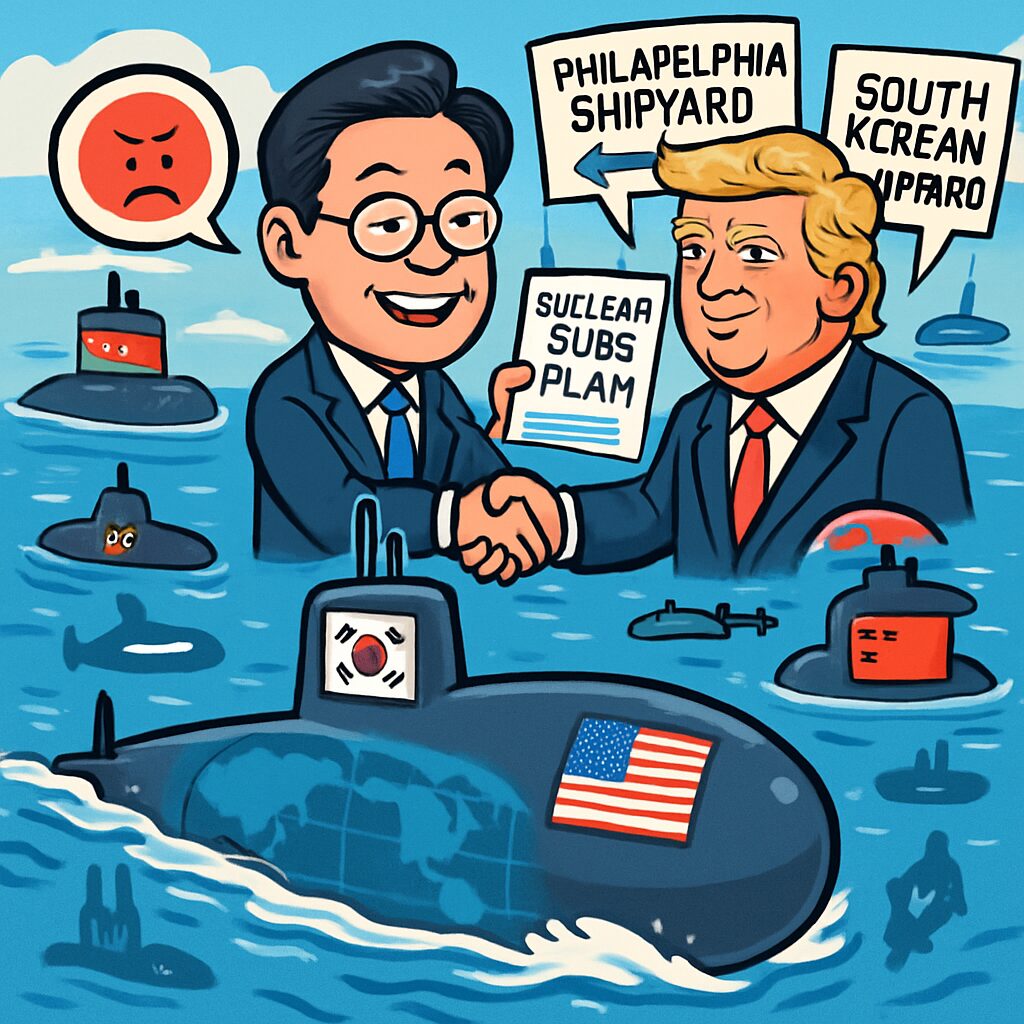
South Korea is advancing plans to build nuclear-powered submarines after receiving approval from U.S. President Donald Trump, aiming to bolster undersea defenses in the Pacific where U.S. submarines face numerical disadvantages. This move could reshape regional security dynamics by enhancing South Korea’s naval capabilities and allowing the U.S. Navy to focus on other hotspots.
The approval came in late October 2025 when South Korean President Lee Jae Myung openly requested the U.S. to lift a long-standing ban on reprocessing spent nuclear fuel, a key hurdle for building nuclear-powered submarines. Trump responded positively on Truth Social, stating he had given South Korea permission to construct these advanced vessels. For South Korea, acquiring nuclear-powered submarines would mark entry into an elite group of nations and provide a strategic edge against threats from North Korea and China in surrounding waters.
Nuclear-powered submarines offer significant advantages over conventional diesel-electric models, including longer submersion times, higher speeds, and quieter operations. South Korea has already demonstrated expertise with its domestically built Jang Yeongsil submarine, which uses lithium-ion batteries for extended underwater endurance. However, experts note that transitioning to nuclear propulsion involves complex technical and logistical challenges, such as sourcing nuclear reactors and ensuring safety protocols.
A major point of contention is where the submarines will be built. Trump indicated they would be constructed at the Philadelphia Shipyard, recently acquired by South Korean conglomerate Hanwha, but South Korean officials prefer domestic production to secure technology transfer and industrial benefits. This disagreement highlights broader tensions in the U.S.-South Korea alliance over defense collaboration and economic interests. Meanwhile, the U.S. submarine fleet, with about 49 attack submarines globally, is stretched thin in the Indo-Pacific, where adversaries like China and Russia have expanded their undersea capabilities.
Regional reactions have been swift and critical. North Korea condemned South Korea’s pursuit of nuclear-powered submarines as a step toward nuclear weaponization, warning it could trigger an arms race. China urged caution and restraint, emphasizing the need to uphold nuclear non-proliferation obligations. Analysts fear that South Korea’s move could exacerbate geopolitical tensions, drawing it deeper into U.S.-led efforts to contain China and potentially inviting economic retaliation.
Despite the challenges, South Korean defense officials express confidence in their ability to build nuclear-powered submarines, citing existing infrastructure and technological prowess. The process is expected to take at least a decade, requiring congressional approval in the U.S. and extensive technical reviews. If successful, it would not only enhance South Korea’s maritime security but also strengthen its role as a key ally in maintaining stability in the Asia-Pacific region.
The implications extend beyond military strategy to economic and diplomatic spheres. Building these submarines could create high-paying jobs in both countries and foster deeper industrial partnerships. However, the long timeline and potential setbacks mean that the full impact may not be realized for years, keeping the issue at the forefront of international security discussions.

