

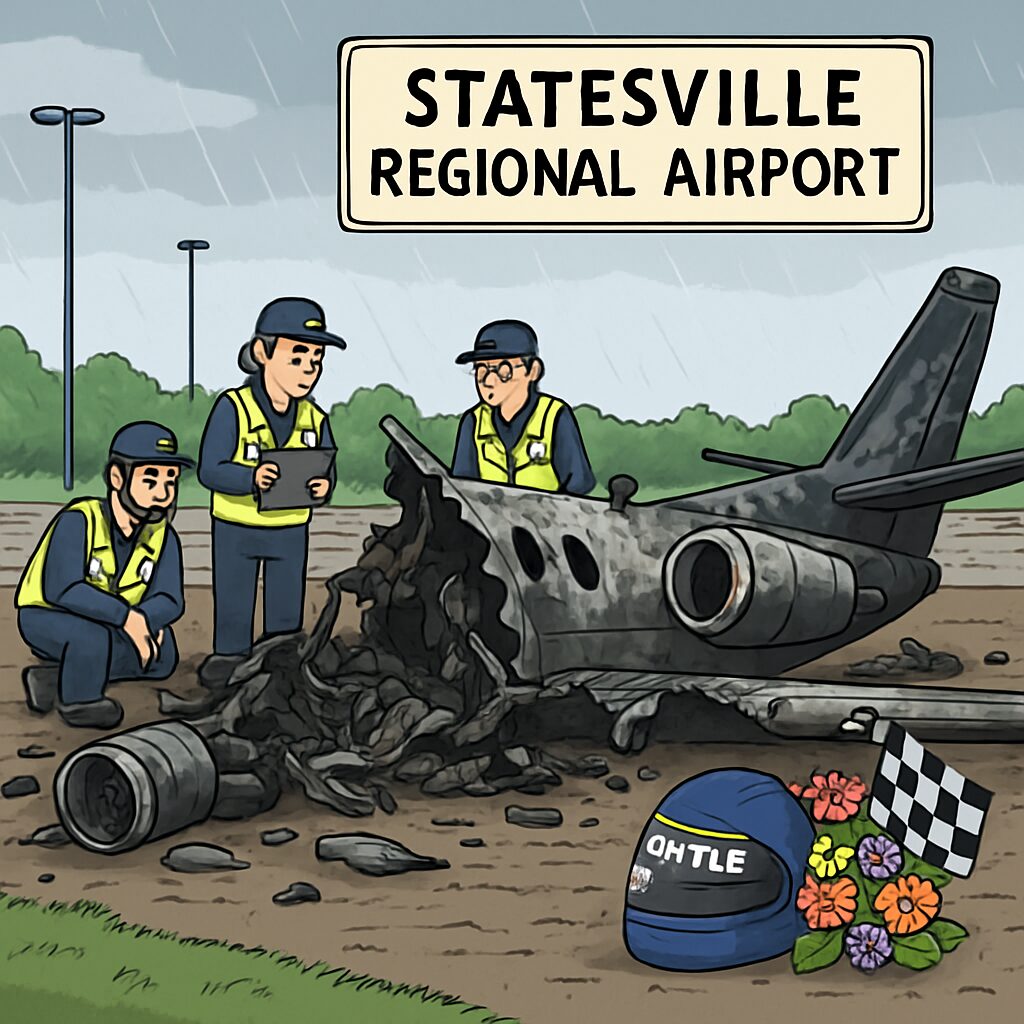
Newly released video footage shows federal investigators meticulously examining the charred remains of a business jet that crashed, killing retired NASCAR driver Greg Biffle and six others, as the National Transportation Safety Board provides updates on the ongoing probe into the tragic accident.
The crash occurred on the morning of December 18, 2025, at Statesville Regional Airport in North Carolina, approximately 45 miles north of Charlotte. Shortly after takeoff, the Cessna C550 jet attempted to return to the airport but plowed into light poles and a tree line about a third of a mile from the runway, erupting into a large fireball upon impact. Authorities confirmed that all seven people on board perished in the incident.
Among the victims were Greg Biffle, 55, a celebrated NASCAR champion with over 50 wins across various circuits, his wife Cristina, their two children Emma (14) and Ryder (5), family friend Craig Wadsworth, and pilots Dennis Dutton and his son Jack Dutton. The Biffle family was en route to Florida when the tragedy unfolded, turning a routine flight into a devastating loss for the motorsports community.
In a press conference on December 20, NTSB board member Michael Graham revealed that investigators are combing through the wreckage, collecting evidence to determine the cause of the crash. Disturbing video released by the NTSB shows agents sifting through the debris, which is broken into pieces and heavily burned, highlighting the severity of the impact. The board confirmed receiving a brief text message from a passenger stating ’emergency landing,’ though the exact circumstances remain unclear.
Flight records indicate the aircraft was registered to a company owned by Biffle, who held a pilot’s license for helicopters and various planes. Interestingly, three individuals on board were licensed pilots: Biffle, Dennis Dutton, and Jack Dutton, who had a private pilot’s license. The NTSB is still investigating who was at the controls during the ill-fated flight, complicating the analysis of pilot actions and decision-making.
Greg Biffle’s legacy extends beyond the racetrack; in 2024, he was recognized for his humanitarian efforts after Hurricane Helene, using his personal helicopter to deliver aid to flood-stricken areas in western North Carolina. His sudden death has sent shockwaves through the NASCAR world, where he was revered not only for his competitive spirit but also for his generosity and community involvement.
The investigation is expected to be lengthy, with officials estimating it could take 12 to 18 months before a final report is produced. Factors such as weather conditions—drizzle and cloudy skies at the time of the crash—and mechanical issues are being scrutinized. The NTSB’s go-team is on site, methodically documenting every piece of evidence to piece together the sequence of events.
As the probe continues, the release of the harrowing video serves as a poignant reminder of the fragility of life and the importance of aviation safety. The tragedy underscores the risks associated with private air travel, even for experienced pilots, and has prompted calls for renewed focus on emergency procedures and aircraft maintenance standards. The motorsports community and fans worldwide mourn the loss of Greg Biffle and his family, while authorities work diligently to uncover the truth behind this heartbreaking crash, hoping to prevent similar incidents in the future.

