

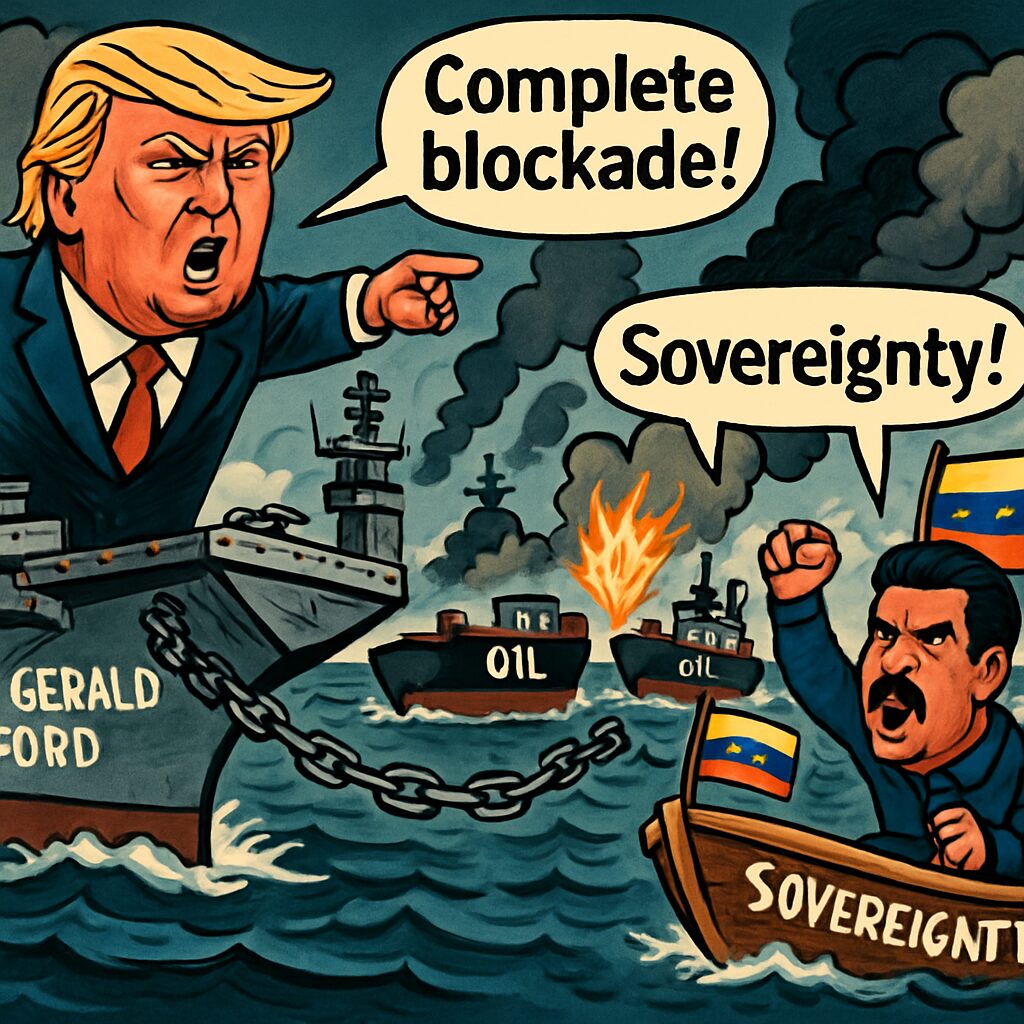
U.S. President Donald Trump has ordered a ‘total and complete’ naval blockade of all sanctioned oil tankers entering and leaving Venezuela, a move denounced by Caracas as warmongering and escalating long-standing tensions over oil and narcotics. The announcement, made on Truth Social on Tuesday, signals a significant intensification of U.S. pressure on Venezuelan President Nicolás Maduro’s government, which Trump has labeled a foreign terrorist organization.
Trump’s order calls for blocking all U.S.-sanctioned oil tankers from Venezuelan waters, citing alleged use of oil revenues to finance terrorism, drug smuggling, and human trafficking. This follows last week’s seizure by U.S. forces of a sanctioned tanker off Venezuela’s coast, an action Venezuela condemned as ‘piracy’ and ‘robbery.’ The U.S. has imposed new sanctions on over 30 ships and targeted Maduro’s relatives, accusing his regime of illicit activities.
In response, Venezuela’s government issued a statement late Tuesday, calling the blockade a ‘grotesque threat’ and a violation of international law, accusing the U.S. of seeking to appropriate Venezuelan resources. President Maduro has vowed to defend national sovereignty, while the U.S. has built up a substantial naval presence in the Caribbean, including the aircraft carrier USS Gerald Ford, within striking distance of Venezuela.
The U.S. military has also conducted strikes on boats allegedly involved in drug trafficking from Venezuela, killing about 100 people since September, though no public evidence of drug shipments has been provided. Trump has repeatedly accused Maduro of colluding with cartels, and the administration has designated the Cartel de los Soles, allegedly led by Maduro, as a foreign terrorist organization, with a $50 million reward for Maduro’s capture.
Reactions from U.S. lawmakers have been mixed, with Congressman Joaquin Castro, a Democrat, stating that the naval blockade is ‘unquestionably an act of war’ and proposing a resolution to end hostilities. Other officials are monitoring the situation, as the U.N. human rights chief warned of intensified crackdowns on civic freedoms in Venezuela. The international community remains divided, with many nations opposing Maduro’s government due to allegations of election rigging and human rights abuses.
Economically, Venezuela’s oil-dependent economy faces further strain, though White House advisors suggest the blockade may not significantly raise global oil prices. However, heavily sanctioned producers like Venezuela have relied on a ‘shadow fleet’ of tankers to evade restrictions, complicating U.S. enforcement efforts. The move risks destabilizing regional stability and could impact oil markets if enforced broadly.
Looking ahead, the U.S. Congress is set to vote on measures related to Venezuela, while Trump has hinted at possible land-based strikes, indicating that Maduro’s ‘days are numbered.’ The situation underscores deepening U.S.-Venezuela hostilities, with potential for further military escalation or diplomatic maneuvers in the coming days.

