

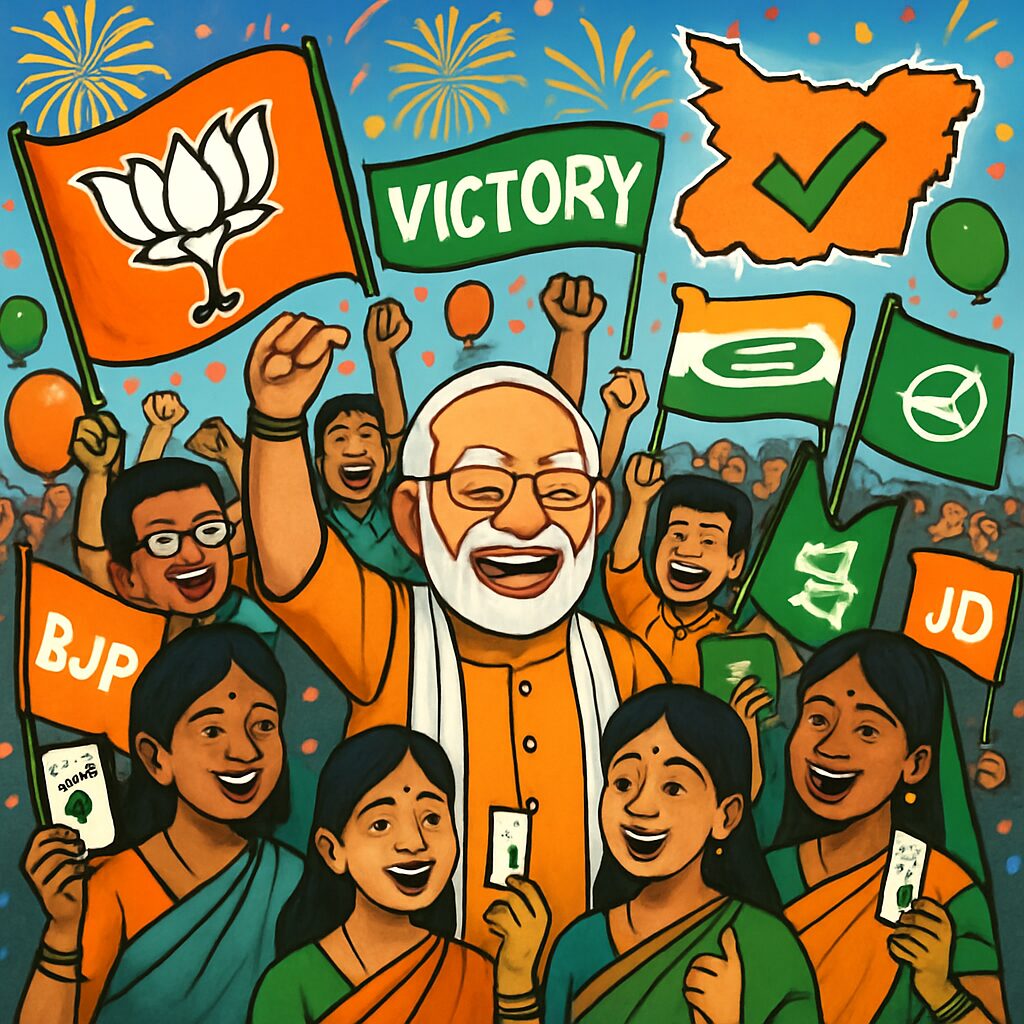
In a decisive political outcome, Indian Prime Minister Narendra Modi’s coalition has celebrated a massive win in the Bihar state assembly elections, securing over 200 seats and reinforcing the ruling party’s dominance ahead of key national polls.
The election, held in two phases on November 6 and 11, saw a record voter turnout of 66.91%, the highest since Bihar’s first elections in 1951. Supporters of the Bharatiya Janata Party (BJP) and its ally Janata Dal (United) erupted in celebrations as results confirmed their alliance’s victory. Prime Minister Modi hailed the result as a victory for democracy, while the opposition coalition led by Congress and Rashtriya Janata Dal remained silent on the outcome.
Bihar, India’s poorest state with over 74 million voters, witnessed an unprecedented female voter participation, with 71.6% of women casting their ballots, the highest in the state’s history. Analysts attribute the BJP-JD(U) sweep partly to welfare schemes targeted at women, which appealed to this demographic. Both alliances had promised financial assistance, but the incumbent government’s initiatives appeared to resonate more strongly.
The BJP-led National Democratic Alliance (NDA) won 202 seats in the 243-member assembly, with JD(U) leader Nitish Kumar set to continue as chief minister. The main opposition, the Indian National Developmental Inclusive Alliance (INDIA), which includes Congress and RJD, failed to make significant gains. This election is seen as a precursor to other state polls in West Bengal, Kerala, and Tamil Nadu next year.
A controversial voter list revision conducted by the Election Commission prior to the polls drew criticism from the opposition, who alleged that it excluded millions of genuine voters, particularly Muslims, to benefit the BJP. The commission and the BJP denied these allegations, stating that the exercise was routine and aimed at ensuring electoral integrity. The revision removed 4.7 million names from the voter list, reducing it to 74.2 million.
The election also highlighted the fading influence of regional stalwarts Nitish Kumar and Lalu Prasad Yadav, both in their 70s and in poor health. Kumar has been chief minister for most of the past two decades, while Yadav, a former chief minister, is out on bail in corruption cases. His son Tejashwi Yadav was the opposition’s chief ministerial candidate, but the alliance’s poor performance signals a shift in Bihar’s political landscape.
The high turnout and decisive win underscore the BJP’s strengthening grip in a state where it has historically struggled to govern alone. Bihar is India’s youngest state by median age (22 years), and the election results may influence the party’s strategies for the 2026 state elections and beyond. Economic issues, migration, and development were key themes during the campaign.
In conclusion, this victory not only consolidates Modi’s political capital but also sets the stage for future electoral battles, with the BJP aiming to expand its footprint in states where it has been weak. The celebration in Patna, Bihar’s capital, reflects the alliance’s confidence as they prepare for the next phase of governance.

