

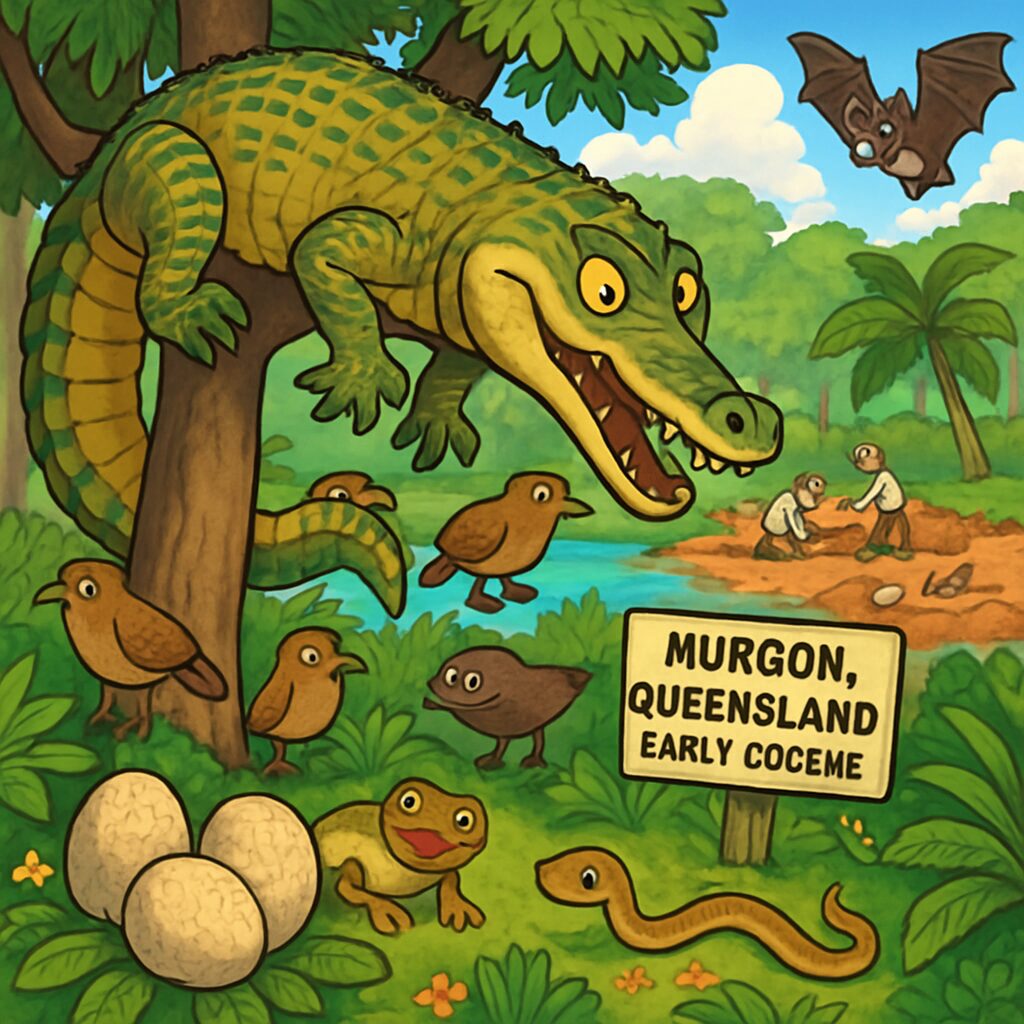
Scientists have uncovered evidence of ancient tree-climbing ‘drop crocs’ in Australia, with the discovery of 55-million-year-old crocodile eggshells that belonged to extinct mekosuchine crocodiles, shedding light on their unique hunting behaviors and ancient ecosystems.
The discovery was made in Murgon, a small town in Queensland, where researchers have been excavating a fossil-rich clay pit in a local grazier’s backyard since the 1980s. This site has yielded numerous prehistoric treasures, including the oldest known crocodile eggshells in Australia, which were recently analyzed and published in the Journal of Vertebrate Paleontology. The eggshells, named Wakkaoolithus godthelpi, were found in the Tingamarra deposit, a location that has become one of Australia’s oldest fossil sites, offering a glimpse into a time when the continent was still connected to Antarctica and South America.
The eggshells belong to mekosuchine crocodiles, a group that dominated inland waters 55 million years ago, long before modern saltwater and freshwater crocodiles arrived in Australia around 3.8 million years ago. Unlike their contemporary relatives, mekosuchines occupied diverse ecological niches, with some species adapting to terrestrial and even arboreal lifestyles. These crocodiles could grow up to five meters long and are believed to have included semi-arboreal hunters that climbed trees to ambush prey, earning them the nickname ‘drop crocs’ for their leopard-like predation tactics.
An international team led by the Institut Català de Paleontologia, including researchers from the University of New South Wales, used advanced optical and electron microscopy to study the eggshell microstructure. This analysis revealed that the crocodiles laid eggs on lake margins, adapting their reproductive strategies to fluctuating environmental conditions. The findings highlight eggshells as an underused resource in paleontology, providing insights into not only anatomy but also reproduction and environmental adaptations of extinct species.
The Murgon fossil site dates back to the early Eocene epoch, featuring a lush forest ecosystem that was home to a rich array of ancient life. This environment included the world’s oldest-known songbirds, Australia’s earliest frogs and snakes, small mammals with South American links, and one of the oldest known bats. Such biodiversity makes Murgon a critical window into prehistoric ecosystems, illustrating how species evolved and interacted before Australia became an independent continent.
The concept of ‘drop crocs’ is supported by earlier discoveries of younger mekosuchine fossils in Queensland’s Riversleigh World Heritage Area, suggesting that some species were at least partly semi-arboreal. Professor Michael Archer, a paleontologist involved in the study, described the idea as ‘bizarre’ but plausible, noting that these crocodiles may have hunted like leopards by dropping from trees onto unsuspecting prey. This behavior underscores the evolutionary adaptability of crocodiles in ancient Australia, filling niches that are uncommon in modern reptiles.
Beyond paleontological interest, this discovery has implications for modern conservation efforts. For instance, studies of fossil records have informed projects like the ‘Burramys Project,’ which used insights from ancient possum fossils to successfully breed endangered Mountain Pygmy-possums in non-alpine sanctuaries. This demonstrates how understanding past ecosystems can guide strategies to save threatened species from contemporary challenges like climate change, turning fossil clues into actionable conservation plans.
Ongoing excavations at Murgon continue to yield surprises, with scientists optimistic that further digging will reveal more about ancient ecosystems and evolutionary history. The dedication of local residents and researchers has already uncovered a wealth of fossils, and future discoveries are expected to enrich our understanding of Australia’s unique fauna, emphasizing the importance of preserving and studying fossil sites for both historical and practical insights.

