

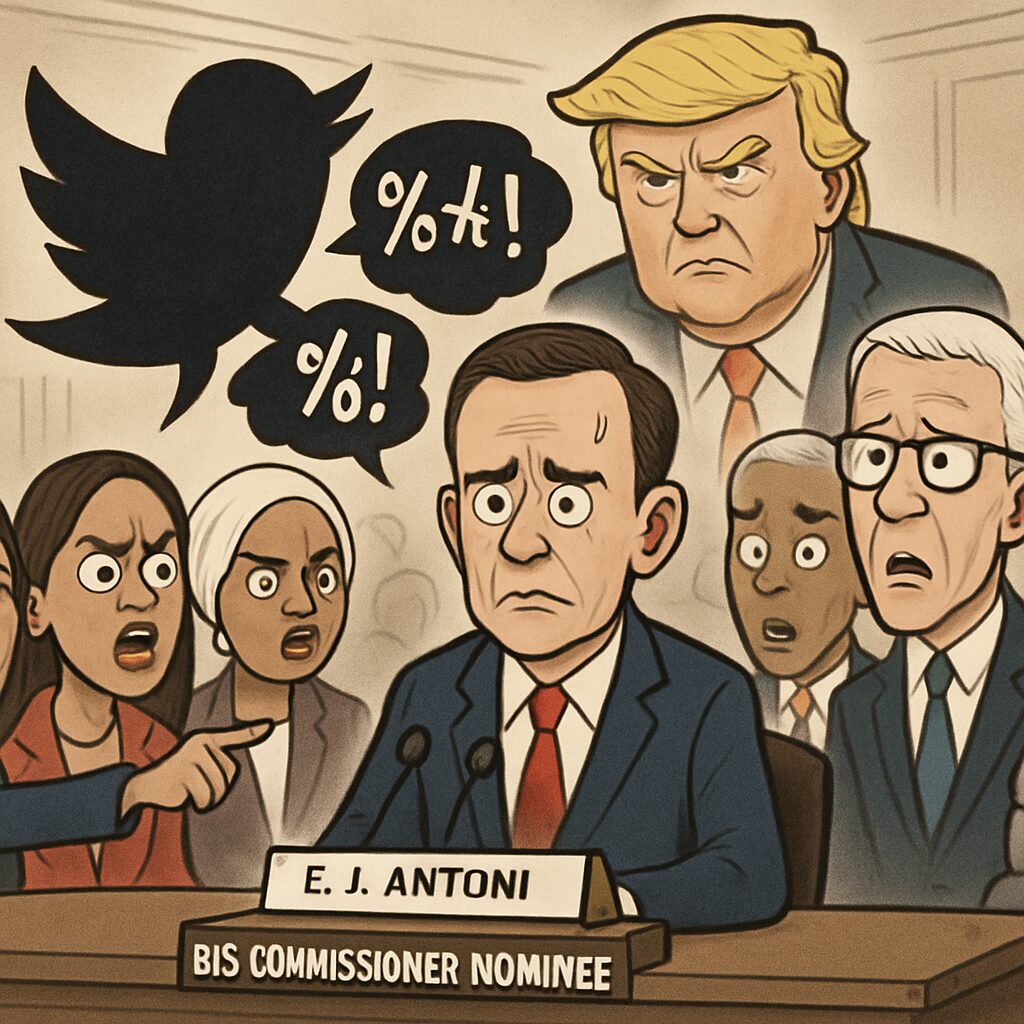

President Donald Trump’s nominee to lead the Bureau of Labor Statistics, E.J. Antoni, is under scrutiny for operating a Twitter account that posted sexually degrading and bigoted attacks, raising questions about his suitability for the role.
E.J. Antoni, a 37-year-old economist at the Heritage Foundation, was nominated by Trump to become the commissioner of the BLS after the president fired the previous commissioner, Erika McEntarfer, in August over disputes about job growth data. This move came after Trump accused the agency of corruption without evidence, following reports that showed weaker job growth than previously estimated. Antoni, an outspoken critic of the nonpartisan BLS, has positioned himself as a watchdog for government accountability but now faces backlash over his digital past.
According to reports from CNN and The Independent, Antoni ran an anonymous Twitter account from 2015 to 2020 under various names, including “@PhDofbombsaway”, where he posted offensive content targeting Democratic figures. The account was used to make degrading and sexist remarks, with posts that included sexually suggestive comments about Vice President Kamala Harris, such as implying she advanced her career through sexual favors. It also contained derogatory statements about LGBTQ+ individuals and promoted baseless conspiracy theories.
The Twitter account featured misogynistic attacks on female politicians like Alexandria Ocasio-Cortez, whom he called a “whack job”, and Ilhan Omar, where he invoked debunked theories about her personal life. Additionally, Antoni made homophobic taunts at gay CNN anchors Anderson Cooper and Don Lemon, and engaged with far-right accounts that spread QAnon and other conspiracy theories. His posts also included insults towards Christine Blasey Ford and the late Senator John McCain, echoing Trump’s controversial rhetoric.
The White House has defended Antoni in response to these revelations. A spokesperson, Taylor Rogers, emphasized Antoni’s qualifications to fix issues at the BLS and restore trust in job reports, without directly addressing the Twitter posts. The statement focused on improving data accuracy through modernizing methods and increasing survey response rates, aligning with Trump’s broader criticisms of the agency’s performance.
Antoni’s nomination occurs in a context of heightened concern about the politicization of economic data. Trump’s dismissal of McEntarfer drew criticism from economists who warned that such actions could erode trust in government statistics and disrupt markets. The BLS plays a critical role in how governments, businesses, and the public view the economy, making the appointment of a commissioner with no prior government experience particularly contentious.
Antoni’s background includes working at conservative think tanks like the Heritage Foundation, which is behind Project 2025, a blueprint for Trump’s second term that suggests consolidating statistical agencies. His academic work is sparse, and he has co-published reports claiming the economy has been in recession since 2022, views that have been criticized by economists across the political spectrum. He has also echoed Trump’s dissatisfaction with the Federal Reserve, accusing it of election interference.
The confirmation process for Antoni is expected to be challenging. His nomination must pass through the Senate’s Health, Education, Labor and Pensions committee, which includes moderate Republicans like Lisa Murkowski and Susan Collins. Committee Chairman Bill Cassidy’s spokesperson indicated that a hearing is planned pending paperwork, which is rare for this position but not unprecedented. Antoni may face questions about his social media history, lack of government experience, and his reported role as a bystander during the January 6 Capitol riot.
This controversy underscores broader issues with Trump’s appointments and the potential impact on the credibility of federal agencies. If confirmed, Antoni’s past behavior could undermine efforts to maintain nonpartisanship in economic reporting, affecting public trust and economic stability. The situation highlights the ongoing tensions between political loyalty and professional integrity in government roles.